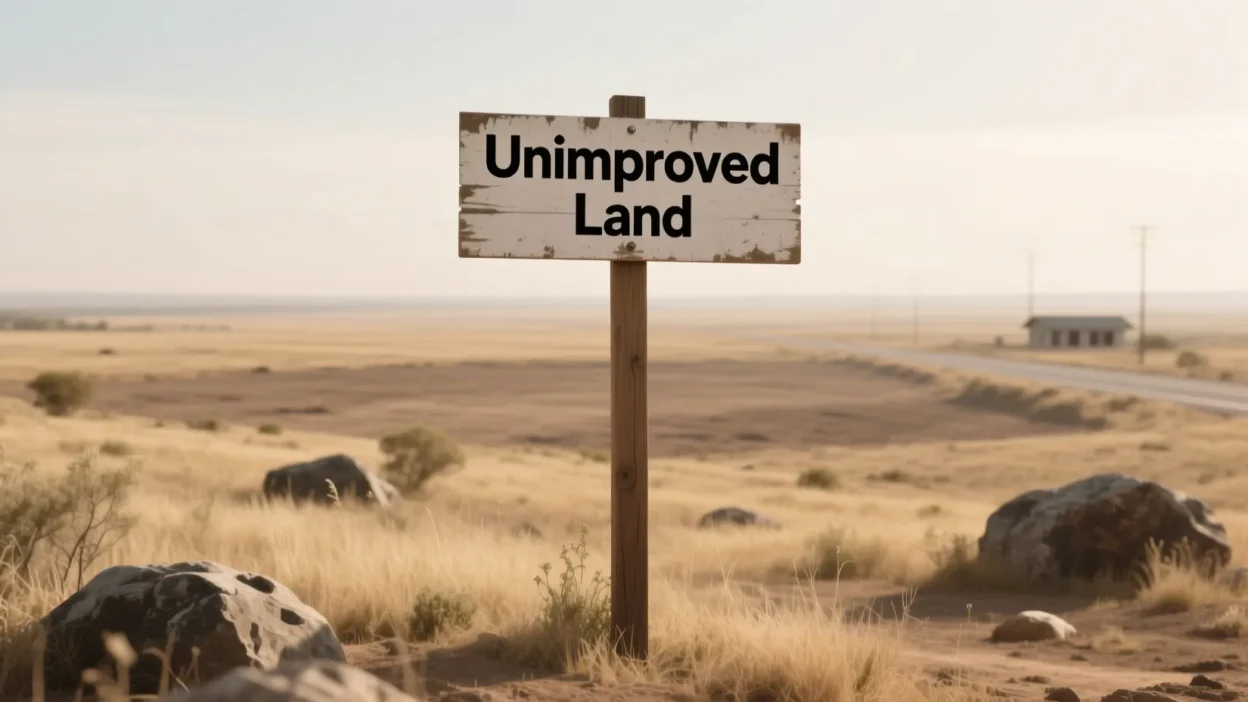
What Does Unimproved Land Mean refers to land that has no buildings, no utilities, and no development on it. This type of land is in its natural state, without roads, electricity, water connections, or construction. People often buy unimproved land for farming, future building plans, or investment because it’s usually cheaper and untouched.
If you’ve ever searched for property or watched someone talk about investing in real estate, you’ve probably seen the phrase “unimproved land.” The first time I came across it, I genuinely thought it meant land that just “didn’t look great.” But then I kept seeing it in listings, legal documents, and real estate videos — clearly, it meant something more specific.
If you’ve had the same confusion, you’re not alone. Real estate terms can feel technical, but this one is actually pretty simple once you break it down.
Quick Answer:
Unimproved land means bare land with no buildings, utilities, roads, or major development.
It’s a raw, untouched, and undeveloped piece of property.
What Does “Unimproved Land” Mean in Simple Words? 🧠
Unimproved land is property that hasn’t been developed or prepared for construction.
This means:
- No buildings
- No utilities (water, electricity, gas)
- No sewer connections
- No grading or clearing
- No streets or driveways
It’s basically raw land in its natural state.
Example sentence:
“We bought unimproved land because we wanted to design everything from scratch.”
In short:
Unimproved land = undeveloped land = raw, untouched property.
Where Is “Unimproved Land” Commonly Used? 📱
You’ll see this term most often in:
- 🏡 Real estate listings
- 📜 Property deeds and contracts
- 📊 Land investment videos
- 🏢 Commercial land descriptions
- 🔍 Appraisals and zoning documents
- 💬 Conversations with realtors
It is:
- ✔️ Formal
- ✔️ Legal/property-related
- ❌ Not used casually or in everyday chats
- ❌ Not a slang term
Examples
1
A: Why is this land so cheap?
B: It’s unimproved — no utilities or buildings.
2
A: What’s the difference between improved and unimproved land?
B: Improved land has utilities; unimproved land doesn’t.
3
A: Is the property ready for construction?
B: Not yet, it’s still unimproved.
4
A: Why does it look so empty?
B: Because it’s completely unimproved.
5
A: Is this good for investment?
B: Some people prefer it because it’s cheaper upfront.
6
A: Does unimproved mean useless?
B: No, it just means undeveloped — you decide what to build.
When to Use and When Not to Use 🕓
✅ Use :
- Talking about real estate listings
- Explaining property conditions
- Discussing development or construction plans
- Comparing different types of land
- Reading or writing legal documents
❌ Do NOT Use It When:
- Talking about houses or buildings
- Describing land with utilities or roads
- Chatting casually about random topics
- Referring to partially developed land
Comparison Table
| Context | Example Phrase | Why It Works |
|---|---|---|
| Friend Chat | “It’s unimproved land — nothing built yet.” | Clear & simple explanation |
| Work Chat | “The parcel remains unimproved at this time.” | Professional & accurate |
| “This property is classified as unimproved land.” | Formal & legally correct |
Similar Terms or Alternatives 🔄
| Term | Meaning | When to Use |
|---|---|---|
| Raw land | Completely natural, no development | When emphasizing untouched condition |
| Vacant land | Land with no buildings | When utilities may exist |
| Improved land | Land with utilities or buildings | Opposite of unimproved |
| Buildable land | Ready for construction | When zoning + utilities are available |
| Developed land | Has infrastructure, utilities, or roads | Urban or prepared property |
FAQs ❓
1. Is unimproved land cheaper?
Yes, it usually costs less because it has no utilities or development.
2. Can you build on unimproved land?
Yes, but you’ll need permits, utilities, grading, and sometimes zoning approval.
3. Does it have any infrastructure?
No. It doesn’t have roads, power lines, water, or sewer systems.
4. Is it a good investment?
It can be, especially for long-term growth or custom development.
5. Is unimproved land the same as vacant land?
Not always. Vacant land might still have utilities, while unimproved land usually does not.
6. Why do listings specify “unimproved”?
To let buyers know the land is undeveloped and will require extra work and costs.
7. Does unimproved land mean it’s untouched by humans?
Not necessarily. It means the land isn’t developed, but people may have used it for farming, grazing, or other purposes.
Conclusion:
In simple words, unimproved land is land that hasn’t been developed or built on. It doesn’t have utilities, roads, or any structures. People choose this type of land because it’s cheaper and gives them the freedom to build or use it the way they want. It’s a good option for long-term planning, farming, or future investment. Buyers just need to check zoning rules and future development plans. With the right research, unimproved land can become a smart and valuable purchase.