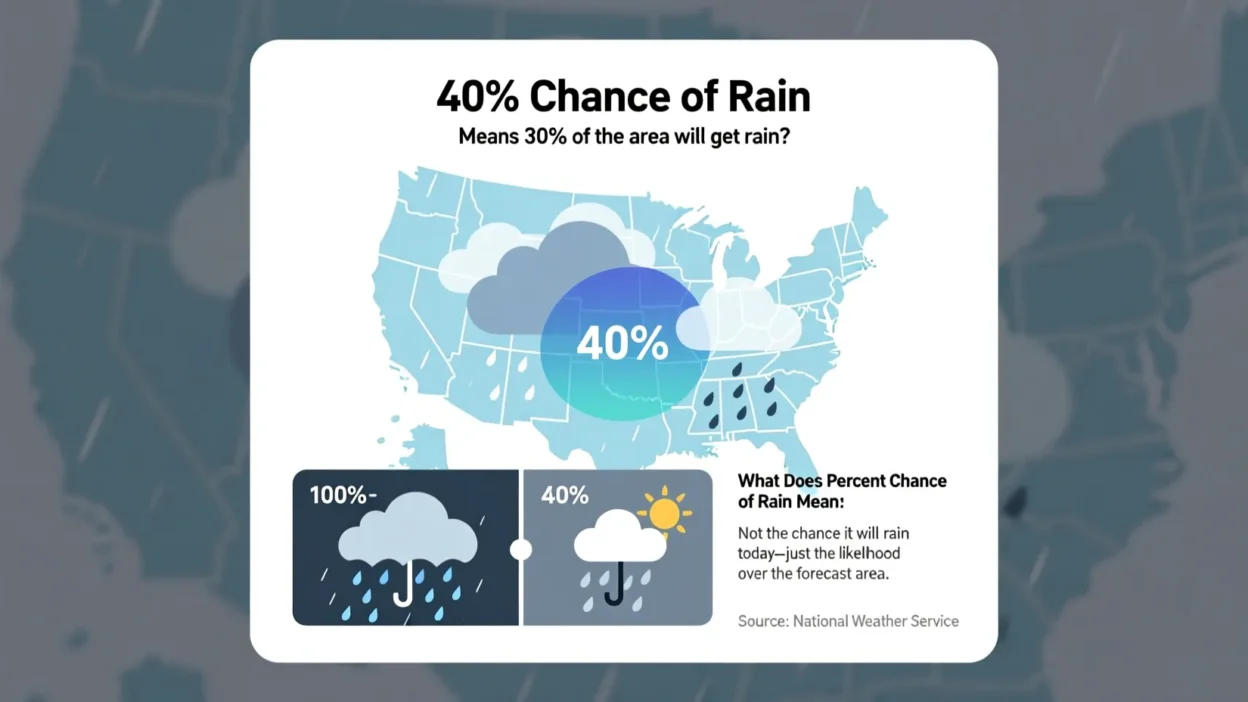
In this guide, you’ll learn what does percent chance of rain mean? and how to understand weather forecasts better. The percent chance of rain, often shown as “20%” or “70%” in forecasts, indicates the likelihood that measurable rain will occur in a specific area during a certain time. It helps people plan their day, decide whether to carry an umbrella, or schedule outdoor activities. Knowing how to interpret this percentage makes weather predictions more practical and less confusing.
The first time I checked the weather forecast and saw a “30% chance of rain,” I wasn’t sure if it meant it would rain a little, a lot, or not at all. Weather forecasts can be confusing, especially with percentages. If you’ve ever wondered what meteorologists mean by the percent chance of rain, how it’s calculated, and how to interpret it for your day, this guide will make it simple and clear.
Quick Answer: The percent chance of rain indicates the probability that measurable rainfall will occur in a specific area during a certain time period. For example, 30% means there’s a 30% likelihood it will rain.
What Does Percent Chance of Rain Mean?
The percent chance of rain (also called PoP — Probability of Precipitation) tells you how likely it is to rain in a certain area during a forecast period.
Simple Example:
“There’s a 40% chance of rain tomorrow.”
→ Meaning: There’s a 40% probability that measurable rain will occur in your area.
Important Notes:
- It does not indicate how much it will rain, only the likelihood.
- A higher percentage means rain is more likely.
- A lower percentage does not guarantee it won’t rain — just that it’s less likely.
In short:
Percent chance of rain = likelihood of rain = probability it will rain in a given area.
Where Is Percent Chance of Rain Commonly Used?
You’ll see this term in:
- Weather apps and websites 📱🌐
- Local news broadcasts 📺
- National weather reports 🌦️
- Outdoor event planning discussions 🎉
Tone:
Informative, factual — used for planning and decision-making, not casual slang.
Examples
A: what’s the forecast for tomorrow?
B: 50% chance of rain, so maybe bring an umbrella
A: should we have the picnic?
B: I’d wait, 70% chance of rain
A: is it going to rain all day?
B: 30% chance, so mostly dry with a few showers
A: do I need a raincoat?
B: yeah, 60% chance — better safe than sorry
A: planning a hike tomorrow
B: check the forecast — 20% chance of rain, low risk
When to Use and When Not to Use
✅ When to Use
- Planning outdoor activities
- Checking weather for travel or commuting
- Making decisions about events, sports, or picnics
❌ When Not to Use
- As casual slang or metaphor
- In contexts unrelated to weather or probability
- When discussing other types of forecasts (unless specified)
Comparison Table
| Context | Example Phrase | Why It Works (or Doesn’t) |
| Weather App | “50% chance of rain” | Clear, standard |
| Conversation | “Better bring a raincoat, 60% chance” | Informative, practical |
| Event Planning | “High chance of rain, postpone picnic” | Useful for decision-making |
| Casual Metaphor | “50% chance of rain on my mood” | Misleading/confusing |
Similar Weather Forecast Terms
| Term | Meaning | When to Use |
| Probability of Precipitation (PoP) | Same as percent chance of rain | Technical/weather discussions |
| Rain likelihood | Informal version of PoP | Casual weather talk |
| Chance of showers | Probability of light rain | Casual or local forecast |
| Rain risk | Emphasizes uncertainty | Outdoor planning |
| Forecasted precipitation | Amount and likelihood combined | Detailed weather reports |
FAQs
1. Does 50% chance of rain mean it will rain half the day?
No, it means there’s a 50% probability of measurable rain in the area, not duration.
2. Can it rain when the forecast is 0%?
It’s very unlikely, but weather is not 100% predictable.
3. What counts as measurable rain?
Typically, at least 0.01 inches of precipitation.
4. Does it tell how heavy the rain will be?
No, it only indicates the likelihood, not intensity.
5. How is it calculated?
Meteorologists use historical data, radar, and models to estimate probability.
6. Can two nearby areas have different percentages?
Yes, forecasts are often local and can vary by neighborhood.
7. Does percent chance change throughout the day?
Yes, hourly forecasts may update probabilities.
8. Is it useful for outdoor events?
Absolutely — it helps decide whether to bring umbrellas, postpone, or prepare.
9. Can it be used for snow or other precipitation?
Yes, the same probability concept applies to snow, sleet, or hail.
10. Is there a way to interpret percentages easily?
Yes, generally: 0–20% = unlikely, 20–50% = possible, 50–80% = likely, 80–100% = very likely.
Conclusion:
Now you know what does percent chance of rain mean? and why it’s important for daily planning. This percentage shows the likelihood that measurable rain will occur in a specific area during a certain period. A higher percent means rain is more likely, while a lower percent suggests it’s less likely. Understanding this helps you decide whether to carry an umbrella, reschedule outdoor activities, or take precautions. Weather forecasts use this to communicate risk clearly. By knowing how to read it, you can stay prepared and avoid unexpected wet days.