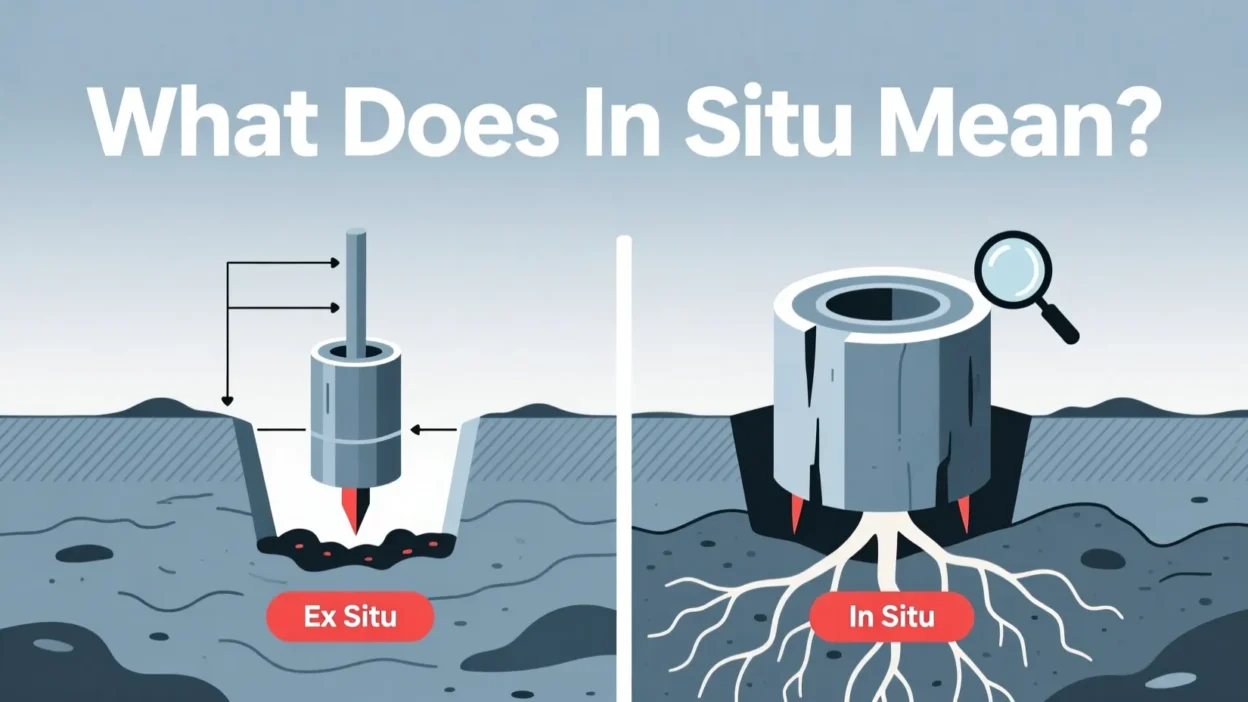
If you’re searching “What does in situ mean,” you’re probably trying to understand a phrase that shows up in science, archaeology, medicine, and even everyday conversation. In simple words, in situ means “in its original place.” It describes something that stays where it naturally belongs instead of being moved. This small Latin phrase helps explain location, position, and context in a clear way.
You might have come across the phrase “in situ” in science class, medical reports, or even archaeology shows and wondered, “What does that even mean?” I remember the first time I read it in a medical report and panicked, thinking it was some kind of serious disease. Later, I learned it’s actually a simple term used in several fields to describe something in its original or natural place.
If you’ve been confused about it too, don’t worry — this phrase is much easier to understand than it sounds.
Quick Answer:
A Latin term meaning “in its original place.”
It’s a formal, scientific/medical term used to describe something located or occurring exactly where it naturally belongs.
What Does “In Situ” Mean in Simple Words? 🧠
Literally means “in place” in Latin. It refers to:
- Something remaining in its original location
- Not moved or altered from where it naturally occurs
- Often used in science, archaeology, and medicine
Examples:
- Medical: “The tumor was detected in situ, meaning it hasn’t spread.”
- Archaeology: “The artifacts were found in situ, exactly where they were left centuries ago.”
In short:
In situ = in its original place = not moved or altered.
Where Is “In Situ” Commonly Used? 📱
You’ll see “in situ” in various professional and academic contexts:
- 🏥 Medicine & pathology (tumors, tissue studies)
- 🔬 Science & research (biology, ecology, chemistry)
- 🏺 Archaeology & paleontology (artifacts, fossils)
- 🏗️ Engineering & geology (soil or structure tests on site)
- 📚 Academic papers
It is:
- ✔️ Formal & professional
- ✔️ Scientific or medical term
- ❌ Not used casually in everyday conversation
Examples
1
A: I saw “carcinoma in situ” in my report.
B: That means the cancer hasn’t spread — it’s in situ.
2
A: What does in situ mean in archaeology?
B: It means archaeologists found the artifacts exactly where they were left.
3
A: The fossil is?
B: Yep, it’s still in the rock where it formed.
4
A: Does in situ mean dangerous?
B: Not necessarily — it just describes location.
5
A: Can you study cells?
B: Yes, it means examining them in their natural environment.
6
A: Is it the same as “on site”?
B: Sort of — emphasizes the original, untouched location.
When to Use and When Not to Use 🕓
✅ Use :
- Talking about something in its original or natural location
- Describing tumors, artifacts, fossils, or experiments
- Writing scientific, medical, or technical documents
- Referring to research or academic observations
❌ Do NOT Use It When:
- Talking casually with friends
- Referring to moved or modified objects
- Using slang or informal speech
- Talking about everyday items
Comparison Table
| Context | Example Phrase | Why It Works |
|---|---|---|
| Medical Report | “Carcinoma in situ detected in the tissue.” | Precise, formal, clinical description |
| Archaeology | “The pottery was discovered in situ.” | Indicates authenticity and original placement |
| Research Paper | “Cells were observed in situ under the microscope.” | Technical and accurate |
Similar Terms or Alternatives
| Term | Meaning | When to Use |
|---|---|---|
| On site | Located at a particular location | Construction or general use |
| In place | In the original position | Everyday context |
| Native | Naturally occurring in a location | Biology or ecology |
| Original location | Unmoved from where it started | Formal or descriptive writing |
| In its environment | Studied in natural conditions | Scientific or research papers |
FAQs❓
1. Do people use in situ only in medicine?
No — doctors, scientists, archaeologists, and engineers use it.
2. What does “carcinoma in situ” mean?
It’s an early-stage cancer that hasn’t spread beyond its original site.
3. Is dangerous?
Not inherently. It just describes location, though context may determine severity.
4. Can refer to experiments?
Researchers call it an in situ study when they observe things in their natural environment.
5. Do we pronounce it like in English?
Yes, typically pronounced “in sit-too.”
6. Is in situ a casual term?
No, it’s formal and mostly used in scientific, medical, or technical contexts.
7. Can someone move artifacts and still call them?
No — once moved, they are no longer in situ.
Conclusion:
Understanding the focus keyword “in situ” helps you recognize when something is studied, found, or observed exactly where it naturally belongs. Whether in science, archaeology, or everyday explanations, this term simply highlights that something is being kept or examined in its original place.