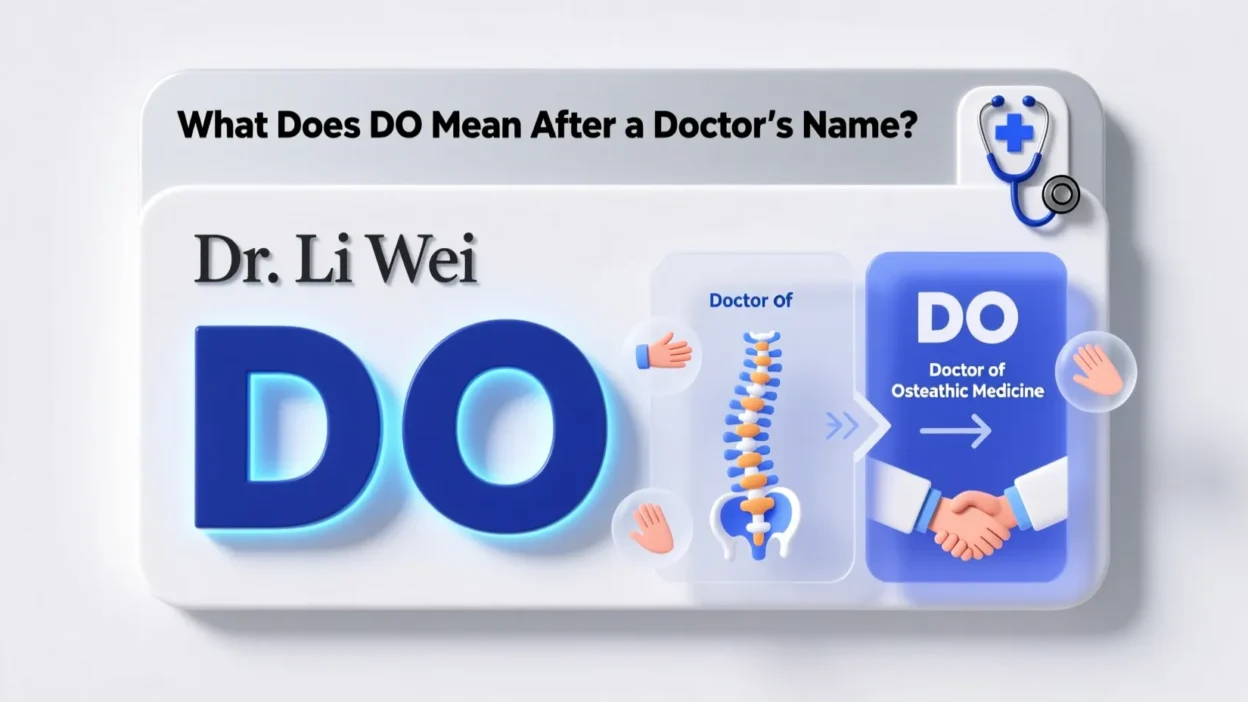
If you’ve ever seen a doctor’s name with “DO” after it, you might wonder what it means. DO stands for Doctor of Osteopathic Medicine. These doctors are fully licensed physicians who can treat patients, prescribe medicine, and perform surgery—just like MDs. The main difference is that DOs focus more on the whole body, prevention, and a hands-on approach to care.
If you’ve ever gone to the doctor and noticed “John Smith, DO” on the office sign or prescription, you might have paused and wondered, “Is that different from an MD?” I remember seeing it for the first time and thinking, Do I need to worry? Is this a special kind of doctor?
If you’ve had the same confusion, don’t worry — you’re not alone. Understanding the difference is actually pretty simple and can help you make informed decisions about your healthcare.
Quick Answer:
“DO” stands for Doctor of Osteopathic Medicine.
It’s a fully licensed physician like an MD, but with additional training in whole-body care and musculoskeletal health.
What Does “DO” Mean After a Doctor’s Name? 🧠
A DO is a Doctor of Osteopathic Medicine. This means:
- They attend medical school just like MDs (Doctor of Medicine).
- They are fully licensed to practice medicine, prescribe medication, and perform surgery.
- They receive extra training in osteopathic manipulative treatment (OMT) — hands-on techniques to treat muscles, joints, and bones.
- They emphasize holistic care, looking at the whole body and lifestyle, not just symptoms.
Example sentence:
“Dr. Lee, DO, treated my back pain with both medication and osteopathic manipulation.”
In short:
DO = Doctor of Osteopathic Medicine = fully licensed physician with holistic and musculoskeletal training.
Where Is “DO” Commonly Used? 📱
You’ll see “DO” mostly in:
- 🏥 Doctor’s offices and clinics
- 🩺 Hospitals and health systems
- 📄 Medical credentials on websites or business cards
- 📝 Prescriptions and lab forms
- 🧑⚕️ Medical directories and professional profiles
It is:
- ✔️ Formal and professional
- ✔️ Indicates medical credentials
- ❌ Not casual or slang
Examples of “DO” in Conversation
1
A: My new doctor has “DO” after her name.
B: That means she’s a Doctor of Osteopathic Medicine.
2
A: Is a DO less qualified than an MD?
B: No — both are fully licensed physicians.
3
A: What’s the difference between a DO and MD?
B: DOs get extra training in musculoskeletal care and holistic approaches.
4
A: Can a DO prescribe medicine?
B: Yes, just like an MD.
5
A: Do DOs do surgeries?
B: Absolutely — they can perform surgeries in hospitals.
6
A: Should I choose a DO for primary care?
B: Many people do — DOs often emphasize preventive and whole-body care.
When to Use and When Not to Use “DO” 🕓
✅ Use “DO” When:
- Referring to a Doctor of Osteopathic Medicine
- Writing professional medical documents
- Choosing or describing a physician
- Introducing a doctor formally
❌ Do NOT Use It When:
- Talking casually about your doctor’s personality
- Confusing it with MD in casual chat (though both are doctors)
- Referring to non-licensed practitioners
- Using slang or informal writing
Comparison Table
| Context | Example Phrase | Why It Works |
|---|---|---|
| Friend Chat | “My new doctor is a DO, so she focuses on whole-body care.” | Clear & casual |
| Work Chat | “Dr. Chen, DO, completed my checkup today.” | Professional & accurate |
| “Please consult Dr. Patel, DO, regarding your condition.” | Formal & medically correct |
Similar Terms or Alternatives 🔄
| Term | Meaning | When to Use |
|---|---|---|
| MD | Doctor of Medicine | Standard allopathic physician |
| Physician | General term for medical doctors | Any licensed medical professional |
| Osteopath | Sometimes used casually | Less formal, historical term |
| Specialist | Doctor focusing on a specific field | Cardiology, neurology, etc. |
| PCP | Primary Care Physician | DO or MD providing general care |
FAQs
1. Is a DO a real doctor?
Yes — DOs are fully licensed physicians.
2. Can a DO perform surgery?
Yes, they can perform surgeries just like MDs.
3. What’s the main difference between a DO and MD?
DOs get extra training in musculoskeletal health and take a holistic approach, but both are licensed doctors.
4. Can a DO prescribe medication?
Absolutely — they can prescribe any medications their license allows.
5. Should I choose a DO or MD?
Both are qualified; DOs often focus on prevention and whole-body care.
6. Is “DO” only used in the US?
Yes — the DO degree is primarily in the United States.
7. Do DOs specialize?
Yes, many DOs specialize in fields like surgery, cardiology, pediatrics, and more.
Conclusion:
In short, seeing DO after a doctor’s name means they are a Doctor of Osteopathic Medicine. They provide the same medical care as other doctors but focus more on preventing illness and treating the whole body. Knowing this can help you choose the right doctor for your needs.