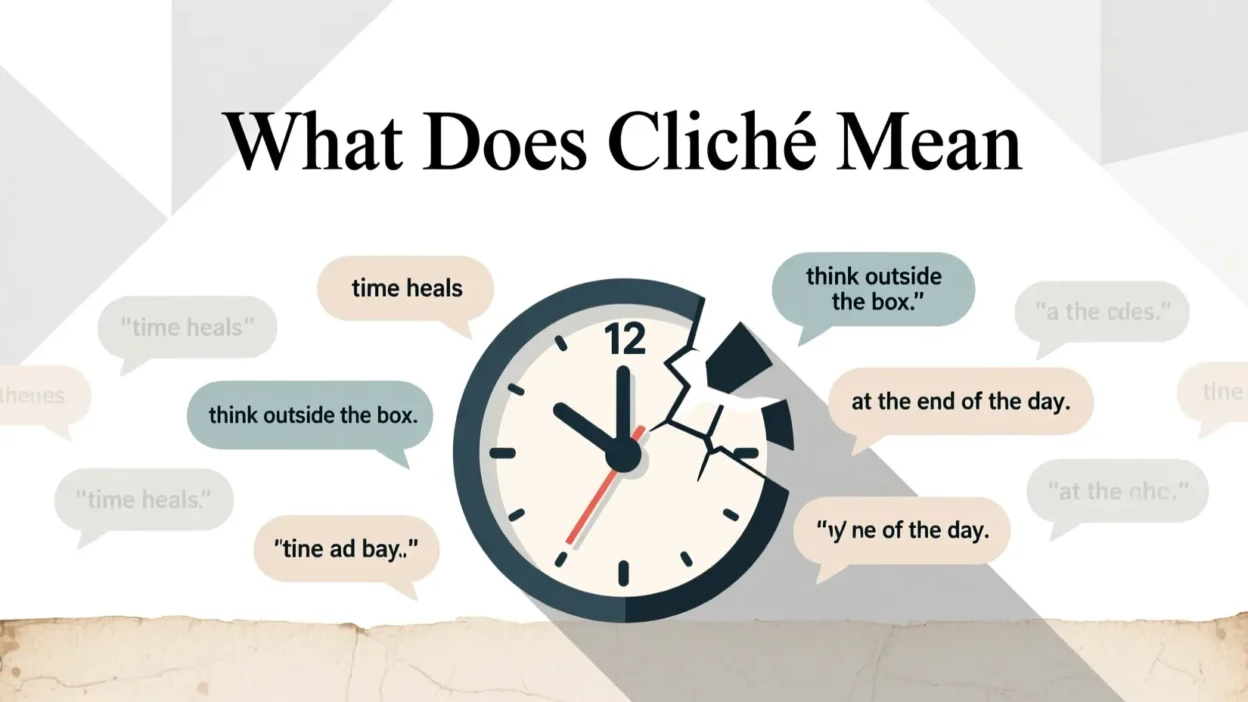
If you are looking to understand what does Cliché mean? it simply refers to an idea, phrase, or action that is used so much that it becomes boring or unoriginal. When something is called a cliché, it means people have seen or heard it many times before, so it no longer feels fresh or creative.
Clichés appear in movies, stories, speeches, and even daily conversations. Knowing this word helps you understand when someone is talking about something predictable or overused.
Have you ever read a sentence or heard a phrase that felt overly familiar, predictable, or unoriginal? That’s likely a cliché. The word is commonly used in writing, speech, and media to describe expressions, ideas, or actions that have been repeated so often that they’ve lost their impact. Knowing what a cliché is can help you improve your writing, recognize overused expressions, and even avoid sounding predictable in conversations. Whether in movies, books, or everyday speech, clichés are everywhere — and understanding them helps you communicate more creatively.
Quick Answer:
Cliché means “an overused phrase, idea, or expression that has lost originality or impact.”
It’s a neutral to slightly negative term often used in writing, speech, and media criticism.
What Does Cliché Mean?
A cliché refers to:
- A phrase, expression, or idea that is repeated too often
- Something that feels predictable or unoriginal
- Commonly seen in writing, movies, speeches, and everyday conversation
Example sentence:
“The phrase ‘time heals all wounds’ is a cliché, but it’s still widely used.”
In short:
Cliché = Overused phrase/idea = Predictable or unoriginal expression.
Where Is Cliché Commonly Used?
- 📝 Writing: essays, books, poetry
- 🎬 Movies, TV shows, and scripts
- 💬 Everyday speech or casual conversations
- 📱 Social media captions and memes
It is:
- ✔️ Neutral to slightly negative in tone
- ✔️ Used to critique writing, speech, or ideas
- ✔️ Recognized in both casual and formal contexts
Examples of Cliché in Conversation
A: “Saying ‘love conquers all’ is kind of a cliché.”
B: “True, it’s overused but still relatable.”
A: “The hero always wins in that movie.”
B: “Yeah, that’s such a cliché plot twist.”
A: “She said, ‘Everything happens for a reason.’”
B: “Classic cliché, but comforting.”
A: “Using ‘once upon a time’ feels cliché in a modern story.”
B: “Writers try to avoid that for originality.”
A: “Breaking up over text seems a bit cliché.”
B: “Agreed, everyone’s done that in movies.”
When to Use and When Not to Use Cliché
✅ When to Use
- Analyzing writing, movies, or media
- Pointing out overused phrases or ideas
- Discussing language and expression in an educational context
❌ When Not to Use
- Casual praise or compliments (unless critiquing)
- Situations where originality is not relevant
- When the audience might not understand the term
Comparison Table
| Context | Example Phrase | Why It Works |
| Writing Critique | “This metaphor feels cliché.” | Points out lack of originality |
| Movie Review | “The ending was cliché.” | Helps describe predictable plot elements |
| Casual Conversation | Avoid using | Might sound pretentious in casual talk |
Similar Words or Alternatives
| Word | Meaning | When to Use |
| Overused | Used too often | Casual, neutral critique |
| Hackneyed | Lacking freshness due to repetition | Formal writing or literary analysis |
| Trite | Unoriginal, dull | Formal critique or reviews |
| Commonplace | Ordinary and unremarkable | Describing predictable ideas |
| Stereotyped | Following predictable patterns | Cultural, media, or literary critique |
FAQs
1. Is cliché a negative word?
It can be slightly negative, implying something is unoriginal or overused.
2. Can clichés be used intentionally?
Yes — sometimes writers use clichés for humor, irony, or relatability.
3. How do I avoid clichés in writing?
Use fresh expressions, metaphors, and unique phrasing instead of overused ideas.
4. Is cliché the same as stereotype?
Not exactly — cliché refers to overused phrases or ideas, while stereotypes relate to generalized assumptions about people or groups.
5. Can a cliché be positive?
Yes — some clichés are comforting or familiar, even if overused.
6. What is an example of a cliché?
“Every cloud has a silver lining” is a classic example.
7. How do I identify a cliché?
If a phrase feels predictable, familiar, or overly common, it’s likely a cliché.
Conclusion:
Understanding what cliché means is simple — it describes something that has been used so many times that it no longer feels original. People use this word when a phrase, idea, or action becomes too predictable or expected. Clichés appear in movies, writing, and everyday speech, and they often make things feel less creative. When you know this term, it becomes easier to notice overused expressions and avoid them in your own communication.
A cliché may still be true, but it loses its power when repeated too often.